Gridiron Heroes: Day-to-day routine as an associate athletic trainer
Everyone is familiar with the saying that a player's best ability is availability.
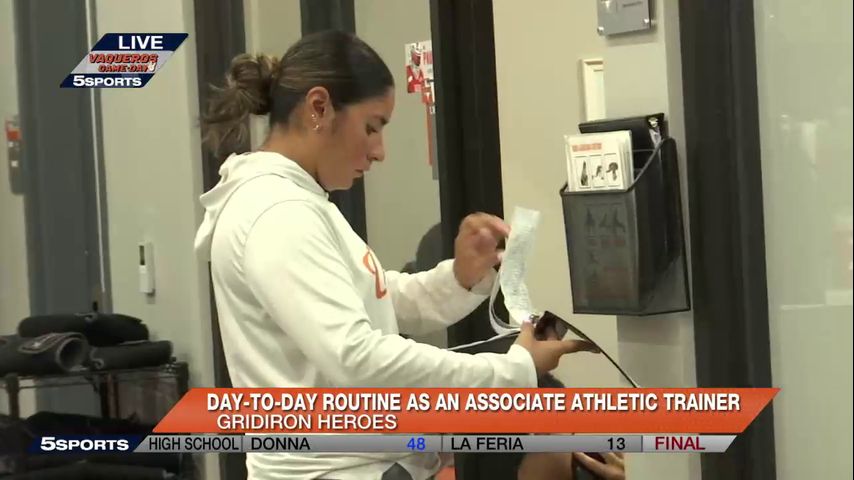
For Dr. Paulina Torres, that means constantly communicating with the players to find the best physical treatment for optimal performance at practice and on game day.
At around 4 a.m., Torres checks in at the Vaqueros Performance Center to get ready to give players treatment.
That includes ankle taping, stretches and formulating rehab assignment exercises.
This profession is one that she became fond of after going through a big injury herself.
"I tore my ACL, I got to see the other side of things. My athletic trainer was amazing and was a great mentor, and I fell in love with the profession. So yeah, this is something I wanted to do," Torres said.
Torres is big on teaching players as much as she can, using materials and information to best equip them to understand their own health.
She even uses an interactive mobile app to understand what the players are physically feeling to come up with the appropriate treatment.
"Educating and the infographics, the pictures, like having that conversation and that visual representation really helps connect with the patient and they understand also why we're doing what we're doing and our plan makes sense," Torres said.
Visual learning also includes going over each rehab assignment exercise with the players and cueing them on what muscle should be firing with that particular movement.
"I think it's super important for them to see it first so it's a lot easier to mirror what i'm doing. So I'll show them the exercise first. You're going to put the band here, you're going to do this movement, it at least gives them a visual like, 'okay I know what I should be doing,' and then I just give them cues like you should be feeling your glute on fire and if you're not feeling that, then we need to fix it," Torres said.
Torres says a student-athlete's mental health is as important as the physical. She keeps an open-door policy for them to reach out in case they need anything.
"We're not only here for your physical health, we're here for your mental health. You build relationships with all my patients, so you get to know them on a personal level. They talk about their lives and experiences, so you get to be there for them as people and humans outside of athletics and injuries," Torres said.
Watch the video above for the full story.
More News