In South Texas, local Republicans push for more wins as Latinos appear to sour on Trump

McALLEN — The morning before Halloween, Alma Pérez walked into a Mexican candy store in the Rio Grande Valley. She was looking for the biggest bags of candy for the lowest price. She scoured the internet for deals. Target, H-E-B and Walmart were too expensive, she said.
Spanish-language radio blared and piñatas hung from the ceiling as Pérez pushed the cart through the store hunting for the five-pound bags of candy that she thought were just $12. Hope for a bargain was dashed when she looked at the price tag.
“Wow. I just don’t know if I’m willing to spend 20 bucks,” she said, looking at the candy. “It’s just outrageous for the typical family out there right now. It’s just outrageous.”
The candy was for a trunk-or-treat event at the county Republican office later that night. Candidates and other conservative organizations would hand out candy to families — one of the many community engagement events Pérez credits with improving the Republican brand in South Texas.
Heading into an election year, those candy prices gnawed at Pérez, an example of an unmet promise by President Donald Trump to bring down prices and tackle affordability issues.
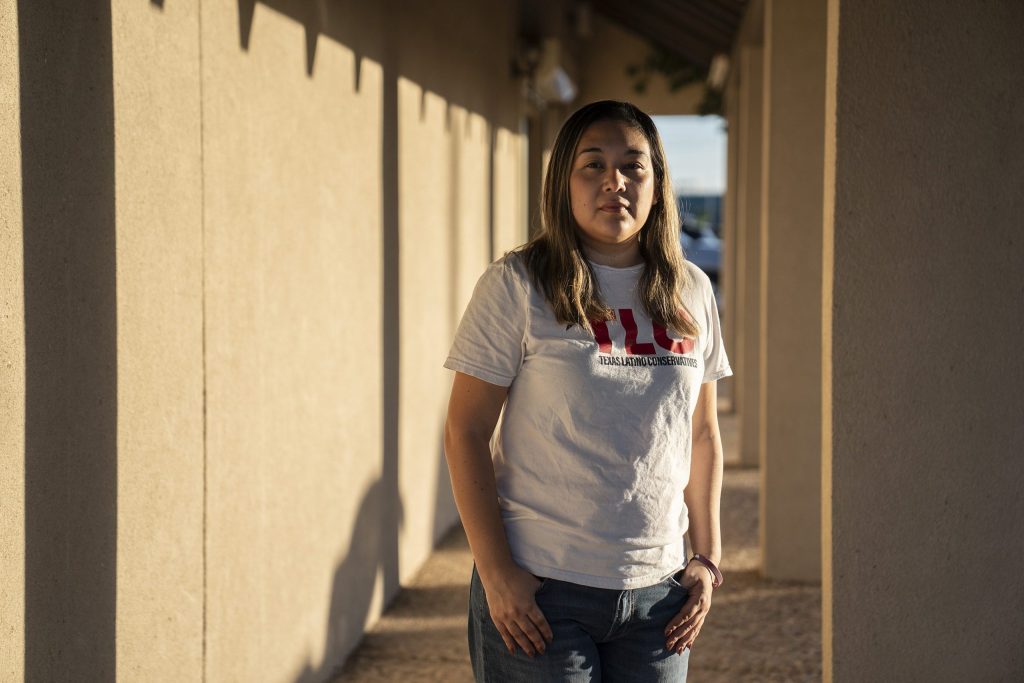
Pérez, 39, is a field director for Texas Latino Conservatives, a nonprofit that registers and encourages Latinos to vote for Republicans and participate in Texas politics. The mom of two is also an active member of the Hidalgo County Young Republicans, where she and her husband got their start in politics.
Years before the Rio Grande Valley, the four-county region that borders Mexico in South Texas, shocked the political world and voted for Trump in 2024, Pérez was voting for Republicans. Her job for the next year is to ensure the Texas GOP does not lose ground in this once Democratic stronghold — and, if all goes according to plan, flip seats in Congress and the Texas House.
But Pérez is worried all the hard work she and her fellow Republicans — many of them part of a new wave of young activists fueled by their faith and their disillusionment with the Democratic Party — will be spoiled by a troublesome economy and the Trump administration’s aggressive deportation tactics. She and others have plans to blitz the community with events throughout the year to inspire more Rio Grande Valley residents to vote for Republican candidates up and down the ballot.
Trump won his second term with the help of a multicultural coalition that included Latino voters in the Rio Grande Valley. His promises throughout the campaign to immediately make groceries less expensive, stop the influx of migrants at the border, and deport known undocumented migrants with criminal records helped win over voters.
Trump’s popularity with Latino voters was a modern high-water mark for a Republican presidential candidate. He won 48% of Latinos nationwide in 2024, according to Pew Research. That’s a remarkable jump from 2016, when he won just 28% of Latino voters. Former President and Texas Gov. George W. Bush previously had the highest support among Latino voters at 44%.
“This is an ongoing trend, and it's not unique to South Texas,” said Mark Lopez, director of race and ethnicity research at Pew Research. “Is it permanent? That remains to be seen. It will depend on the candidates. It will depend on the state of the country."
***
The first hint that the Rio Grande Valley was fertile ground for Republicans came in 2016, when Democrat Hillary Clinton, Trump’s first opponent for the White House, failed to energize Latino voters. In 2018, Sen. Ted Cruz spent the last days of his successful reelection campaign in Mission. By 2020, Trump flipped 14 of 28 border counties and made significant inroads in many others, including Hidalgo.
More time and attention from state and national Republicans followed. Gov. Greg Abbott announced his 2022 reelection campaign in McAllen at a Hispanic leadership conference. That summer, Mayra Flores, a Republican, narrowly won a special election to represent the congressional district that included Brownsville, becoming the first Mexican-born woman to serve in Congress. And while she lost her seat during the general election, fellow Republican Monica De La Cruz, flipped the neighboring congressional district that includes McAllen.
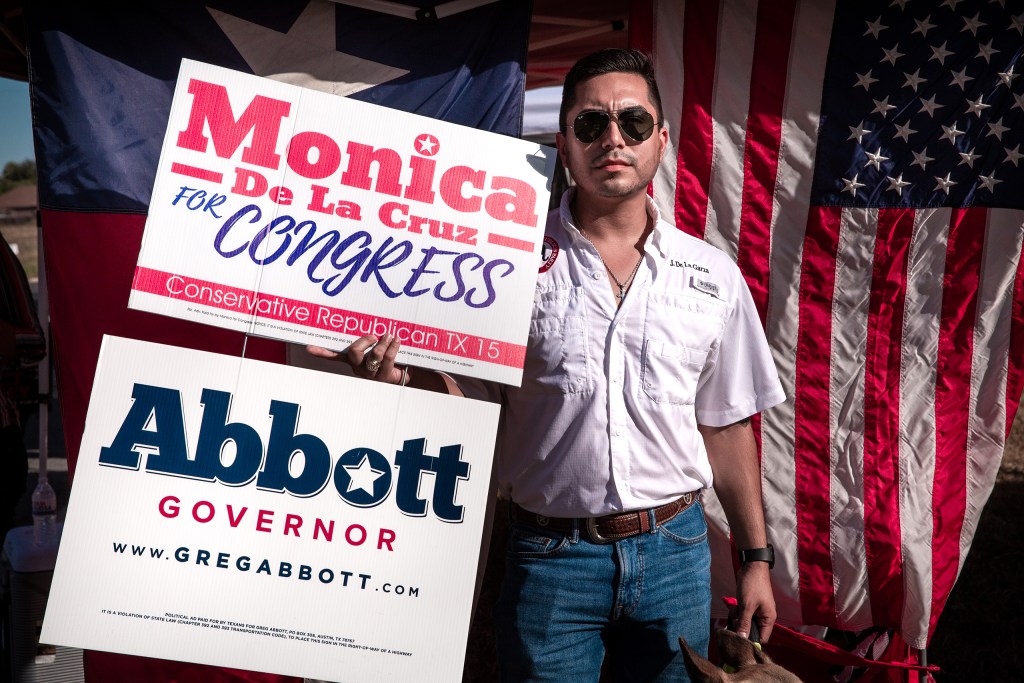
Jordan De La Garza, 29, helped De La Cruz win in 2022 and again in 2024 as her campaign’s political director.
Born and raised in Seguin, near San Antonio, De La Garza is now the president of the Hidalgo County Young Republicans. His late father was a conservative. His mother was more socially liberal, he said. Neither were overtly political. But his entry into politics was foretold by his great-grandmother, who rubbed his mother’s belly while he was still in the womb.
“I've always been patriotic,” he said. “I love the colors, red, white, and blue. I've always been into God, family and country ever since I was little.”
In 2020, while living in the Valley and working on the campaign trail, De La Garza said voters initially scoffed at efforts to convince them to vote for conservative politicians. But he and his fellow Republicans kept showing up at football games, grocery stores and other community events, talking about conservative values as the Democrats “radicalized” on COVID-19, the border, race and gender.
Latino voters didn’t leave the Democratic Party, De La Garza said, the Democratic Party left Latino voters.
“Hispanics are very hardworking, God-driven people,” he said. “Hispanics are naturally very conservative, and naturally, they should align with the Republican Party because the Republican Party's values are conservative. And these days, the left has become so, so far left, they have left behind conservative Democrats.”
Trump’s campaign promises may have won over voters. How he keeps those promises may decide whether voters in the Valley stick with him. While border crossings have dropped to a historic low, the once-bustling economy in the state’s fifth most populous region has slowed. Immigration arrests have struck fear into workers. And the decision to allow health care insurance subsidies to expire has disproportionately negative consequences for Valley residents.
An October poll by Pew found that 70% of U.S. Latinos disapproved of Trump’s job performance. More than two-thirds disapproved of the administration’s approach to immigration. And 61% say Trump’s policies have made economic conditions worse. Trump did maintain high levels of support from his voters, the survey found. Eight out of 10 Latino Trump voters approved of the president’s job performance. However, that’s down from nine out of 10 at the start of his current term.
De La Garza, like many of his peers, has faith that Trump will deliver, — even if it’s not as immediate as Trump promised.
“It’s gonna take a while,” he said. “Trump is just planting the seed and watering the plant, but after is when that plant really grows and blossoms.”
The Young Republicans will spend the first half of the year driving up membership and registering new voters, De La Garza said. He plans to host mixers at local bars and restaurants and show up at other community events like flea markets and farmers' markets. Campaigns will canvas neighborhoods where the GOP has previously increased support to ensure they don’t lose ground — and neighborhoods where they haven’t.
“It all happens at the door, he said. “When people feel listened to and reasoned with, they feel important. These people are important.”
***
An estimated 1 million Latinos across the country will turn 18 each year for at least the next decade, according to Pew Research. The numbers are more striking in Texas. Nearly half of all people under 18 — an estimated 3.9 million people — are Latinos.
“Our national voter survey suggested that one-in-ten Latino voters in Texas voted for the first time in 2024,” said Gabe Sanchez, a researcher at the Brookings Institution, a nonpartisan think tank in Washington. “Their connections to a political party are still being decided. They don’t have a huge connection to either party. You might see swings in 2024.”
That makes Pérez's and De La Garza’s work all the more urgent. Helping them is Alexis Uscanga, a 22-year-old college student at the University of Texas Rio Grande Valley, where 91% of students are Hispanic.
Uscanga is the president of the university’s Turning Point chapter. Founded by the late Charlie Kirk, Turning Point USA’s college chapters work to promote conservative values on campuses. Kirk, who was assassinated last year, became best known for his campus tours that featured “Prove Me Wrong” debates.
When he was still in high school, Uscanga began listening to Kirk’s podcast during the COVID-19 pandemic. Once a Trump-hating, Beto O’Rourke supporter, Uscanga wrapped himself in Kirk’s messages — especially about getting involved in politics.
“I took that to heart,” Uscanga said. “There are too many old people in our government who are deciding things for us. Especially on the Republican side.”
Uscanga and his Turning Point chapter campaigned for Trump ahead of the 2024 election. And they haven’t let up. The club boasts 120 members. Around 30 are active, Uscanga said.
In the fall, the club hosted tailgate parties for the university's new football team. Politics wasn’t the point. Like the other efforts by Republicans in Hidalgo County, the goal is to show up and normalize Republicans as part of the community.
“I’m not the type to want to shove politics down people’s throats. People just want to enjoy the game,” he said. “If someone wants to engage in a conversation, then we'll give them a conversation.”
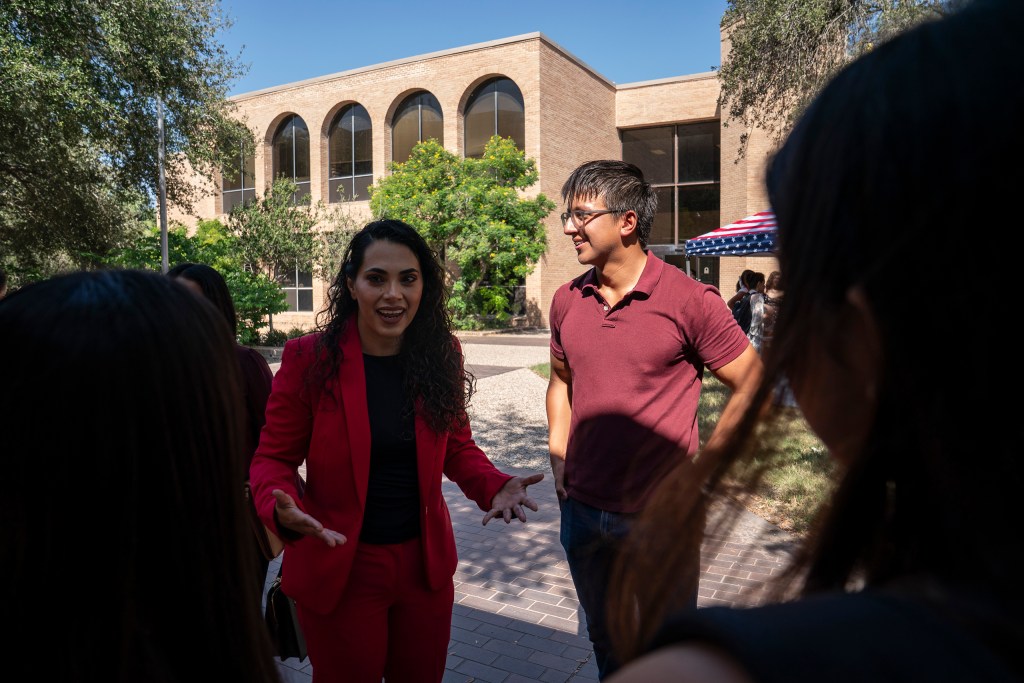
But a late October Turning Point event on campus foreshadowed some of the challenges and hostilities that lay ahead. Uscanga hosted Flores, the one-term congresswoman who is running for reelection, for a Kirk-styled “Prove Me Wrong” debate. Clad in a red pantsuit, Flores clashed with students for more than two hours in sweltering 90-degree heat over the government shutdown, health care, and LGBTQ+ rights.
“Fuck you, fuck you, bitch,” a student yelled at the former congresswoman.
Flores shot back.
“You do not represent America. You do not represent South Texas. We represent South Texas,” she said, pointing to members of the Turning Point Club.
Luis Valdez, a 22-year-old junior studying business administration, told the crowd he voted for Trump in 2024. It was his first vote for a presidential candidate. And now he was disheartened.
“I’m a little let down by the overpromises,” Valdez said. “I have a problem with the promises regarding the economy and jobs. … The administration was going to bring jobs.”
What, he asked Flores, are you going to do to bring jobs here? How are you going to help families escape from generational poverty?
Flores took credit for bringing hundreds of millions of dollars to South Texas during her seven months in Congress. And she suggested she could do it again, but said more oversight was needed of local governments.
Her answer wasn’t convincing to Valdez who pressed her, saying he wasn’t sure he could support Republicans again. “I’m on the fence,” he said. “The economy's worse.”
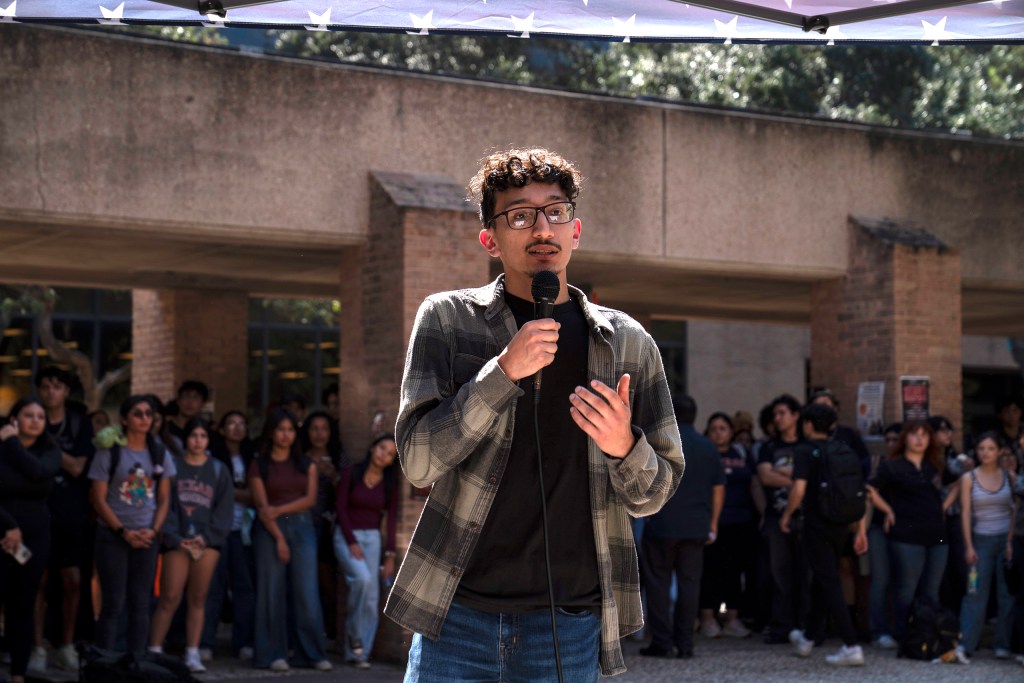
“The economy is not worse,” she said. “I’m sorry you’re feeling that way, that it’s not going as fast as you want. By the end of 2028, your life is going to be better.”
After the event, Uscanga walked Flores back to her car. They were giddy.
“I think there's a lot of passionate people on all sides of the spectrum here who want to have conversations who want to talk about politics and talk about policy,” Uscanga said. “I think this is the start of something really good.”
***
Pérez, the Texas Latino Conservatives field director, saw clips of the Turning Point event on social media.
It wasn’t the sort of event she would host, she said, in between the Mexican candy store and Sam's Club, where she’d pick up another bag of candy for the Halloween party. It just brings out hecklers.
“I think that ground game is really with new voters, registering new voters,” she said. “It's so much easier to persuade a new voter versus an existing voter who has been voting Democrats for generations.”
It’s events such as the trunk-or-treat, a Thanksgiving potluck, and a Christmas party, where families are invited to make ornaments, that have helped the GOP here grow its base, Pérez said. Trump trains — convoys of vehicles draped in Trump flags — also got people’s attention.
“We realized that the more we open the doors to the community, the more new people we would see,” she said.

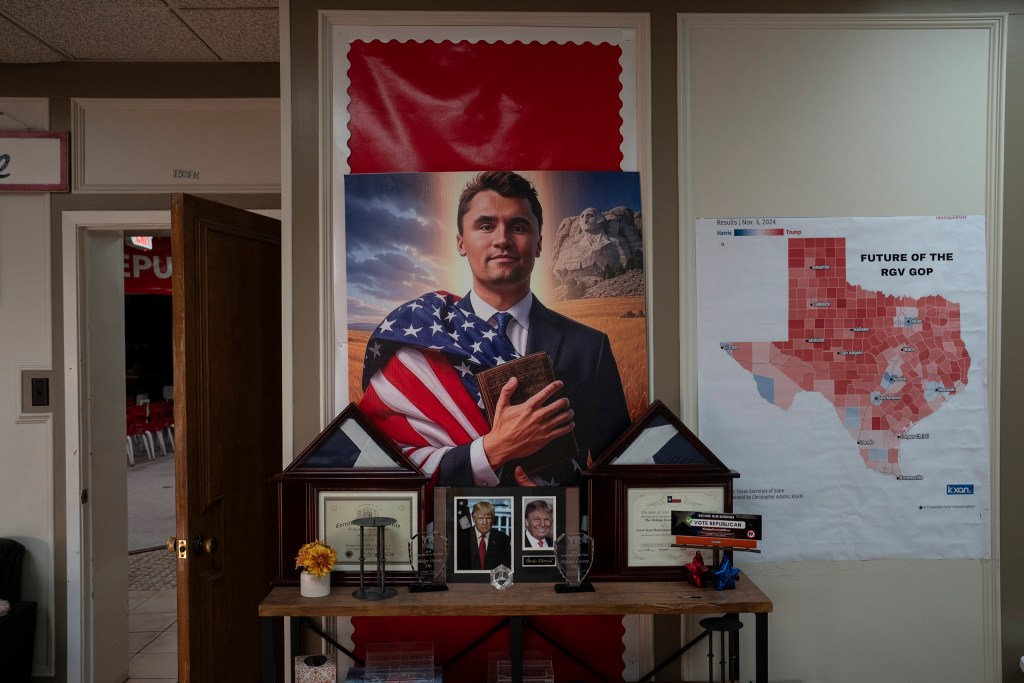
A little after 5 p.m. on the last Thursday of October, a stream of princesses, superheroes and unicorns — most under 4 feet tall — began to make their way around the parking lot of the GOP headquarters, bags open for Halloween candy. Families visited open car trunks run by campaign volunteers for Gov. Greg Abbott and Donald Huffines, a state comptroller candidate. Among the cars was a life-sized cutout of Trump standing next to a makeshift miniature golf green, an homage to the president’s private Mar-a-Lago Club.
After helping set up, Robert Cantu, the Hidalgo County Republican Party chair, sat in his office to reflect on the party’s victories and chart out its future.
Trump may have won the Valley in 2024, but Republicans down ballot were less successful. Cruz, who successfully won reelection to the U.S. Senate statewide, lost the county by 7 points. And six of the eight state House seats in the area were won by Democrats. In fact, no Republican has even run for Texas House District 40, which includes Edinburg, since 2016. That will change in 2026, Cantu said.
“We feel very confident that we're going to flip a lot of these seats,” he said.
Back outside, families circulated. A few only spoke Spanish. Several said they didn’t realize they were visiting the Republican Party headquarters. Tony Cordova, 43, said he voted for Harris. When he learned he had brought his family to the GOP offices, he laughed.
“That explains the giant cardboard Trump,” he said. It was nice that the Republicans hosted the event, he said, but they wouldn’t get his vote in 2026. “I’m not a fan.”
***
Between Halloween and the New Year, a dash of off-year elections sparked a renewed interest in “affordability.”
Pérez is convinced more than ever that cost-of-living will be the turf on which the midterms are fought. It will take time for the economy to stabilize, she said in late December, the same day it was announced that inflation dropped just below 3%.
Pérez knows voters will want to talk about Trump. She isn’t sure how much she’ll engage. She was not an initial supporter. In 2016, she first backed Marco Rubio, then a U.S. senator, now Trump’s secretary of state. And in 2024, she gave Florida Gov. Ron DeSantis a very close look. Pérez is aware that many outsiders see the devotion to Trump and consider it a cult.
“Not all of us are in that cult,” she said. “I can assure you that the majority of us are not. We’re just normal.”
She is just as quick to criticize leaders of her own party as she is Democrats — especially on issues that matter to South Texas and Hispanics. That includes immigration, which, she said, no one really wants to solve.
Participation is the panacea, she said. Her plan is to encourage Valley Republicans to be more engaged in the state party. The state GOP’s priorities do not “reflect what we live in South Texas,” she said. “If we don’t have Hispanic representation … and voice our concerns, the party is never going to shift.”
And she wants everyday voters to put pressure on candidates and elected officials to do something about the costs of groceries, housing and taxes. Her own taxes have shot up as her home value has increased. She’s worried about her younger sister, who is house hunting. Pérez guesses that she will pay too much for too little.
The people running for office will have their four-point plan, but they come from different means. Do they really know the economic pain people are living with, Pérez wondered?
"We have to actively be talking to them,” she said. “We have to make sure we're being heard."
Disclosure: H-E-B and University of Texas - Rio Grande Valley have been financial supporters of The Texas Tribune, a nonprofit, nonpartisan news organization that is funded in part by donations from members, foundations and corporate sponsors. Financial supporters play no role in the Tribune's journalism. Find a complete list of them here.
This article first appeared on The Texas Tribune.
More News