AI enters the race: How Texas primary candidates are using it in 2026 ads

Editor's note: The Texas Tribune does not use AI to produce news content. Our policy forbids the publication of news photos or videos that are created or altered using generative AI. When AI-generated images are themselves the subject of a story, we label them clearly with both a watermark and a caption.
Texas voters heading to the polls for the 2026 primary are encountering a campaign trail shaped by artificial intelligence, as candidates use the technology to mock opponents and dramatize political attacks.
A bill in the Texas Legislature last year that would have required disclosures in political ads that use AI or that substantially alter real images passed the Texas House but stalled in the Senate and never became law. That means AI in political advertising remains a free-for-all as the technology is rapidly becoming more accessible and realistic.
Nationwide, the use of AI in campaigns ranges from animated satire to sophisticated deepfakes, testing both the limits of political speech and the ability of voters to discern fact from digital fiction.
Disinformation around elections is not new: cheapfakes, out-of-context images and videos, and edited images and videos have been part of the disinformation landscape in recent years. Now, AI-generated content is just another tool — a faster and more accessible one — for spreading disinformation and misinformation.
“AI-generated videos and images will, in the long term, desensitize voters to the importance of factually accurate information,” said Ernersto Calvo, director of the Interdisciplinary Lab for Computational Social Science and Professor of Government and Politics at the University of Maryland. “It is increasingly difficult, even for well-informed actors, to distinguish which of the vast number of videos and images are true and which are false.”
To understand the scope of this trend, The Texas Tribune reviewed Facebook and YouTube ads from the past five months for candidates running for high-profile offices in the March primary.
Here’s how candidates are using AI in their political ads. Low-tech AI videos to mock political rivals and to attack party peers
In mid-January, Attorney General Ken Paxton, who is running for U.S. Senate, shared a video using some AI showing his Republican primary opponent Sen. John Cornyn dancing with Democratic U.S. Rep. Jasmine Crockett of Dallas. On social media, he wrote: “NEW AD: John Cornyn has been dancing late into the night with liberal lunatics like Jasmine Crockett and selling us out every step of the way. That’s why he called Crockett his ‘dance partner,’ and she said Cornyn was her ‘best partner’ in the Senate”.
“This ad doesn’t attack her on substance, but instead launches attacks for bipartisanship, something that most voters appreciate”, Crockett’s campaign told KXAN. “Paxton’s AI-generated digital ad attacks Congresswoman Crockett for crossing the aisle to deliver solutions to our opioid crisis, to stop fentanyl deaths, and address hunger in Texas”.
The video published by Paxton in his social media accounts includes a disclaimer about the AI generated content at the end of the video. But there are also clear signs that it is AI-generated: the participants’ unnatural movements, the faceless humans in the background of the video, and the blurred background. It clearly looks like animation.

Even AI that is clearly fake or a parody has its dangers, said Angie Holan, director of the International Fact-Checking Network.
“Those of us who have fact-checked content online know that lots of people mistake parody for actual content,” Holan said. “They're busy, they're scrolling quickly, and they just don't pick up on the clues that what they're looking at isn't real. Too often, the people who made the fake ads are happy if they're taken literally.”
Videos of this kind have also made their way into down-ballot races, including state-level legislative races in Texas. Kat Wall, a GOP candidate running for a state House seat, published a satirical fake YouTube video against her opponent Texas Rep. Angelia Orr, R-Itasca, that uses AI to display deepfakes of Vladimir Putin and Xi Jinping. The video features synthetic voice clones and manipulated visuals of the candidate to mock her “voting record,” framing her as an ally to foreign adversaries.
At the very end, the narrator states: “This ad is a parody using AI video tools”.
There are several indicators in the content that point out the video was generated using AI. For example, there is a lack of synchronization between the lips of the figure representing Orr and her character’s voice.
Additionally, the clothing and setting closely resemble an interview she gave to Waco-Tribune Herald four years ago. In that footage, however, noticeable differences can be observed — such as the shape of her teeth — which is a characteristic sign of AI-generated videos.
A spokesperson for Wall acknowledged that AI can be a deceptive campaign weapon, but said their campaign has “safeguards” including clear language disclosing the use of AI, ensuring it only is used to make points that can be proven with documentation, and citing the sources for viewers to “find the documentary proof.”
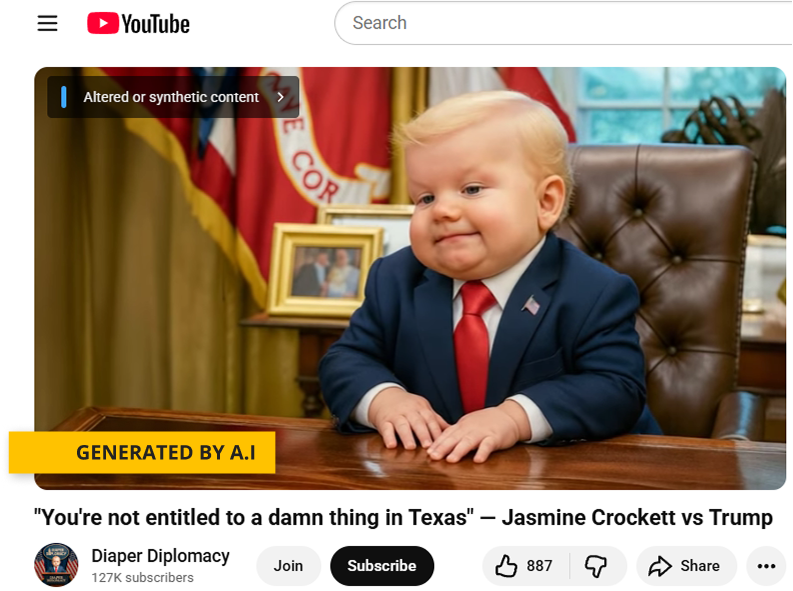
Some of the AI videos reviewed show obvious cartoons. On December 11th, 2025, U.S. Rep. Jasmine Crockett posted an AI video on her Facebook page, featuring herself as a baby accusing Baby Trump of rigging Texas elections.
The content was published by Diaper Diplomacy, a YouTube channel of political parodies that often use AI to portray public figures as children. In YouTube the video has an “Altered or synthetic content” sign, which means “sound or visuals were significantly edited or digitally generated,” according to the platform.
Sophisticated AI satire videos
On Jan. 21, Cornyn posted an AI-generated fake video depicting the U.S. Rep. Wesley Hunt as a “show dog”.
Unlike the other AI ads, the attack against Wesley Hunt showcased a more sophisticated level of digital manipulation, and lacked any disclosure about the use of the technology.
However, some specialized AI-detection tools — such as Hive Moderation and Google’s AI chatbot, Gemini — indicated that there is a 99% probability that the video was created using AI.

Beyond the tools — which are not 100% reliable and can make errors — there are certain visual elements that suggest the video was generated using AI: blurred signs in the background of the opening frames, a U.S. flag folded in an unusual way, somewhat unnatural movements by the figure intended to represent Hunt, and the video’s excessively polished quality.
“The technology is developing so fast,” said Katie Sanders, editor-in-chief of PolitiFact. “What I suspect can happen is that it makes people more skeptical of what they see. If you feel that you can’t believe what you are seeing, you might be inclined to not believe anything”.
(Wesly hunt video screenshot)
On February 8th, Crockett released an ad titled “Texans don’t back down. We rise.” In this ad, Crockett presents herself as a “warrior” and a “champion” for Texans' votes and rights, while characterizing the current system as “broken” and communities as “terrorized.”
According to Gemini, the last image of the video, where Crockett appears surrounded by dozens of people, is made with Google’s AI.
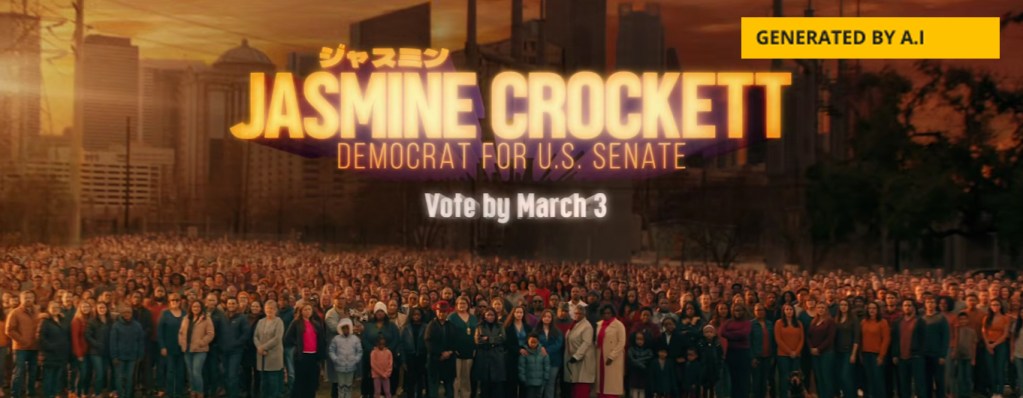
Also, while it cannot be confirmed with 100% certainty due to the video’s quality — as sometimes happens with this type of content— some faces in the image and the outlines of several bodies appear blurred and lack clear definition, unlike Crockett’s figure and the people immediately surrounding her.
On social media, Crockett’s ad was criticized for portraying supporters with AI. Crockett’s campaign responded but did not address whether AI was used.
“Our new ad was created through hundreds of hours of real craft and collaboration between creatives and union labor. This ad is a deliberate and meaningful attempt to connect with new voters and energize the electorate,” her campaign responded.
Crockett, Cornyn and Paxton’s campaigns either did not respond or declined comment to the Tribune.

Cornyn has posted several AI-generated images portraying Democrats like state Rep. James Talarico of Austin and former U.S. Rep. Beto O'Rourke.
In a series of AI-generated images and videos, Talarico, who is running for U.S. Senate, is transformed into 'Taxula,' a fanged, vampiric caricature dressed in a suit, clutching a 'Tax Bill' with distorted, AI-warped fingers.
Cornyn has also shared an AI-generated image of O'Rourke, portraying “Franken-Beto” as a stitched-together monster powered by “California Mandates” and “Chaos”, attacking his energy policies. And an AI-generated “Halloween Special” graphic depicting former U.S. Rep. Colin Allred of Dallas as a green-skinned witch brewing a “Bidenomics” cauldron in front of a dark, storm-struck Texas Capitol.
The golden rule, according to experts, is to think twice before sharing when you see suspicious content on social media.
“Ask yourself: Where did this come from? Is this from an official campaign source? Has any news organization verified it?” Holan said.
“If something seems designed to provoke emotions or outrage, treat that as a warning sign and look at it closely before you share it. Also, be more intentional about where you get information. Rely on established news sources, local journalists who know the candidates, and verified campaign communications rather than content that just appears in your feeds.”
Disclosure: Facebook and Google have been financial supporters of The Texas Tribune, a nonprofit, nonpartisan news organization that is funded in part by donations from members, foundations and corporate sponsors. Financial supporters play no role in the Tribune's journalism. Find a complete list of them here.
This article first appeared on The Texas Tribune.
More News