Texas to defend law requiring schools to post Ten Commandments. Here’s what to know.
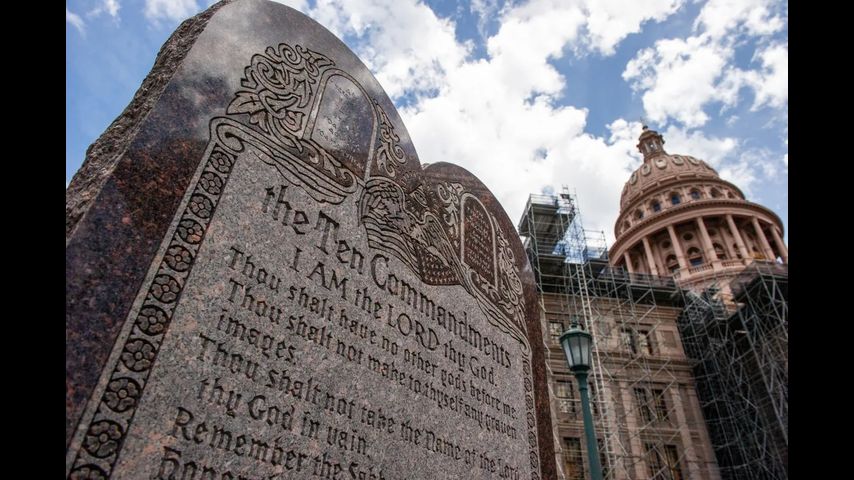
The 5th U.S. Circuit Court of Appeals is scheduled to hear arguments Tuesday over a Texas law requiring public schools to display posters of the Ten Commandments in classrooms.
All 17 active judges on the court will hear the case — Rabbi Nathan v. Alamo Heights Independent School District — alongside a similar challenge in Louisiana, the first state to pass a Ten Commandments requirement.
The case could play a central role in the national debate over whether the laws violate the First Amendment’s establishment clause, which prohibits governments from endorsing or promoting a particular religion.
Here’s what we know.
Background: The Texas Legislature passed Senate Bill 10 in 2025, with Gov. Greg Abbott signing it into law last June. It requires public schools to display donated posters of the Ten Commandments, sized at least 16 by 20 inches, in a visible space on classroom walls.
After SB 10’s passage, 16 families represented by a coalition of civil rights organizations, including the American Civil Liberties Union of Texas, sued 11 school districts to block what lawyers called “catastrophically unconstitutional” legislation.
U.S. District Judge Fred Biery agreed, blocking the law from taking effect in the districts named in the lawsuit: Alamo Heights, North East, Lackland, Northside, Austin, Lake Travis, Dripping Springs, Houston, Fort Bend, Cypress-Fairbanks and Plano.
Biery concluded the law improperly favors Christianity over other faiths and said it would likely interfere with families’ “exercise of their sincere religious or nonreligious beliefs in substantial ways.”
Texas Attorney General Ken Paxton asked the 5th Circuit Court to overturn Biery’s ruling and allow all 17 active judges on the court to hear both the Texas and Louisiana cases together.
A federal judge blocked Louisiana’s Ten Commandments law from taking effect in 2024, a decision unanimously upheld last year by a panel of three judges on the 5th Circuit Court. With all active judges on the court now hearing the cases, Texas and Louisiana officials hope for a more favorable ruling.
Twelve of the appeals court’s 17 active judges were appointed by Republican presidents. The court is considered one of the most conservative in the nation.
Tuesday’s arguments will not include two other prominent Texas lawsuits filed by civil rights organizations challenging the Ten Commandments law.
One of those lawsuits resulted in a federal judge blocking 14 more school districts from complying with the law. The other, asking a federal judge to block all Texas schools from following the law, is still in its early stages.
Why the families sued: The lawsuit argues that the law subjects the families’ children to a state-imposed Protestant version of the Ten Commandments that many religious and nonreligious Texans do not recognize.
The families believe the law seeks to pressure students into observing and adopting Texas officials’ preferred religious principles.
They also say the law will inflict harm by alienating children of those who do not follow the state’s preferred religion, as well as by undercutting parents’ authority to direct their children’s religious education.
“Posting the Ten Commandments in public schools is un-American and un-Baptist,” Griff Martin, a pastor, parent and plaintiff in the lawsuit, said in a statement. “S.B. 10 undermines the separation of church and state as a bedrock principle of my family’s Baptist heritage. Baptists have long held that the government has no role in religion — so that our faith may remain free and authentic.”
The families’ lawyers argue that because children are legally required to attend school, they have virtually no way of avoiding Texas’ required version of the Ten Commandments.
The U.S. Supreme Court, in 1980, found public school displays of the Ten Commandments unconstitutional, and civil rights attorneys argue that only the Supreme Court can overturn its previous rulings.
What the state argues: Paxton’s office says the Ten Commandments played a significant role in the nation’s history and heritage. The state believes previous rulings from federal courts and the U.S. Supreme Court did not examine that historical significance.
Paxton's office notes that the Supreme Court recently eliminated a test, established by a previous ruling, that determined when a government had unconstitutionally endorsed or established a religion.
“There is no legal reason to stop Texas from honoring a core ethical foundation of our law, especially not a bogus claim about the ‘separation of church and state,’ which is a phrase found nowhere in the Constitution,” Paxton said in a recent statement.
The attorney general’s office sees the Ten Commandments requirement as requiring only a “passive display on the wall” that does not rise to the level of coercion because students are free to ignore the posters. The law might cross the line, state lawyers say, if it had sought to incorporate the Ten Commandments into lessons or assignments.
The posters must go up in Texas classrooms only if donated by someone, and the law does not specify what would happen if districts choose not to comply. The state views that as evidence no threat or harm is posed to families, even though Paxton issued a legal advisory threatening action if schools do not comply and has sued three districts for alleged noncompliance.
What’s next: The 5th Circuit Court will rule on the constitutionality of the Texas and Louisiana laws at a future date. Its decision could be appealed to the U.S. Supreme Court.
This article first appeared on The Texas Tribune.
More News