Texas’ GOP Senate runoff pits an old guard-backed institutionalist against a Trump-picked flamethrower
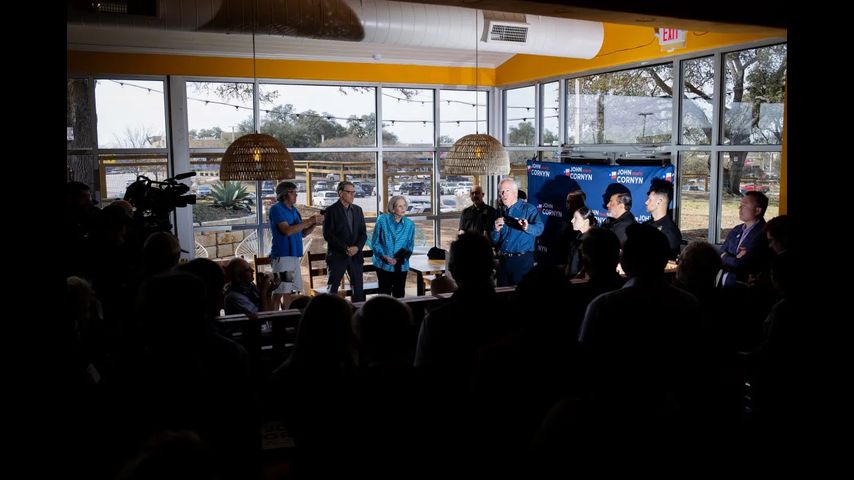
WASHINGTON — When Michael Burgess first ran for Congress in 2002, his name was sandwiched between two now-familiar politicians on the Republican ballot.
Above him was John Cornyn, making his first bid for U.S. Senate. Further down was Ken Paxton, a then first-time candidate running for the state House in Collin County.
All three won those initial races in a landmark year for the Texas GOP, when the party established the trifecta control of Austin it’s maintained ever since. Twenty-four years later, Cornyn and Paxton are on a collision course, battling in an ugly runoff to be the Republican candidate for the U.S. Senate seat Cornyn has occupied for over two decades.
Burgess, a Lewisville Republican and affable policy wonk, retired at the end of 2024. Having observed both for decades, he’s backing Cornyn.
“Who’s a better person to help [the Trump administration] — someone who’s seen as a steady hand and has been there and understands how things work and how things don’t work?” Burgess said in an interview last week. “Or someone who’s going to come in and [say] let’s blow it all up and then see what we can deal with at the end? There is a need for disruptors in our system, and we have disruptors in our system. But we can’t all be disruptors. Some of us have to be builders.”
Trump himself disagrees. The president endorsed Paxton Tuesday, expressly citing the attorney general’s willingness to disrupt convention.
Paxton, Trump said, “is a Strong Supporter of TERMINATING THE FILIBUSTER”. He is a “Fighter, and knows how to WIN” and, critically, “someone who has always been extremely loyal to me and our AMAZING MAGA MOVEMENT.”
The May 26 runoff will be the most consequential trial yet for the values championed by the older GOP set — statesmanship, Washington knowhow, dealmaking, personal character — set against the brash, battle-centric, maximum warfare approach, marked by a willingness to cull their own ranks and demand absolutely loyalty, favored by Trump and supporters of Paxton.
Burgess is part of the GOP's establishment old guard that has gone to bat for Cornyn, in defiance of much of the MAGA base, emphasizing the elements of the senator’s character that make him well-regarded among his colleagues in Washington — staid, even-keeled, focused on the legislative process, someone who understands the importance of finding common ground.
Those values, they say, are what makes Cornyn an effective senator — and why he deserves to keep the job.
But they’re also why Paxton and his supporters, many of whom are aligned with the newer, more MAGA-ified GOP, see Cornyn as a pariah in the modern day GOP. Paxton has built his political brand around fighting the old guard that Cornyn represents, at least in the eyes of Paxton’s supporters.
“Cornyn is weak, ineffective and very bad for the Republican Party,” the narrator says in one recent Paxton TV ad. “It’s time for change in Washington. Ken Paxton is a conservative fighter who sued Biden over 100 times, fought for border security and will take a sledgehammer to the establishment.”
Trump’s evaluation process hinges on different axes than the Texas GOP old guard — namely, a fighter’s mentality and personal loyalty. Cornyn, who expressed doubts about Trump’s electability in 2023, evidently didn’t meet the standard.
Paxton routinely dings Cornyn on the length of his political career, painting him as an establishment creature who lacks the fight the base is looking for. The runoff between the two is a war between the party’s wings, pitting the senior senator against a rival who has fought and beat the GOP establishment Cornyn helped build and who wears their dismay like a badge of honor.
Cornyn has plenty of endorsements from current elected officials and political players — the National Border Patrol Council, the Texas Alliance for Life, a bevy of local agricultural groups and seven current Republican House representatives from Texas, from longtime Reps. Michael McCaul and Roger Williams to newer members like Craig Goldman and Nathaniel Moran.
But he’s dominating Paxton among the retired GOP politicians who ran Austin and Washington in the 1990s and 2000s, when Republican control of Texas was newer and shakier. Cornyn’s old guard backers are more likely to remember the era of Democratic dominance in the Lone Star State, and more concerned about the potential to lose the general election.
The former congressmen who have endorsed Cornyn, out of office and free to speak their minds, expressed concerns about the state of the party — and how primaries have changed toward the ends of their careers or in the years since they’ve left. They’re worried about a Republican electorate that relishes fighting one another more than winning general elections or engaging in the legislative process. Their belief in Cornyn and concerns about the state of the electorate have now led them to the opposite side of Trump in this fight.
The runoff is a test of whether voters are still listening.
Ted Poe, a Republican from Humble, represented the 2nd Congressional District from 2005 to 2019. He’s backing Cornyn because the senator was a reliable partner in the upper chamber and because Texas benefits from the seniority Cornyn has accrued, Poe said in an interview earlier this month.
He sees the anti-incumbent streak playing out in Texas as a trend in primaries across the country — and he’s worried about where it leads.
“[To] be an incumbent, even if you are a conservative … that ain’t good enough for a lot of people,” Poe said. “They just [say], ‘Well, we need to get rid of them, we need to clean house.’ What you do then is you self-destruct. You self-destruct your power.”
Paxton, of course, now has the most relevant endorsement of them all — Trump’s backing. And the 2026 Republican electorate is a different animal than when Cornyn rose to statewide prominence some three decades ago. Accustomed to decades of being in power, today’s GOP voters are used to — and sometimes revel in — their biggest fights being intra-party.
“My goodness, the biggest battles that we've had in the last couple of cycles have been in primaries,” said Henry Bonilla, a Cornyn-supporting San Antonio Republican who flipped a congressional seat in 1992 and served until he was defeated by a Democrat in 2006. “That is a huge change from what we saw [previously] …There's just a lot of anger in the country right now, and I think it stimulates that kind of political activity.”
Cornyn sees Paxton as a threat to the era of Republican Party dominance that he and many of his seasoned endorsers worked to build.
“I think there’s a small minority of people who think we should be about the politics of exclusion and subtraction,” Cornyn said in an interview Monday, before the Trump endorsement. “But both parties, historically, have been coalitions. And we have a big enough tent that we can have some diversity of thought within the Republican Party. Because if all you do is want to exclude people who don’t think exactly the way you do, you risk being a minority and not having any voice at all.”
Vitriol in Republican primaries has “always been a feature,” Burgess said, but feels more “prominent” these days than in the past. The bloodsport nature of GOP contests contributed to his decision to retire at the end of 2024.
“It does get tiresome to see the intra-party [fighting],” Burgess said. “Come on. What do we believe? What are we for? ... And if it’s just to try to tear each other down, I don’t know that that’s necessarily useful for the country.”
The Republican primary, in which Cornyn finished 1.5 percentage points ahead of Paxton, proved there are significant constituencies in the Texas GOP for both men’s approaches.
But runoff elections, in which turnout is lower, tend to favor the more hardline candidate. In that climate, not everyone is sure there’s a willing majority for Cornyn’s brand of experience and legislative productivity.
“I don’t know,” Poe said. “They’re sure quiet. … It seems like it’s the trend to be the other way.”
The builders vs. the disruptors
Former elected officials have been among the loudest and proudest defenders of Cornyn. Rick Perry, who occupied the Governor’s Mansion from 2000 to 2015, chairs the Lone Star Freedom Project, a group that spent $17.4 million boosting the senator during the first round of the primary. Former Rep. Louie Gohmert, R-Tyler, a flamethrower who primaried Paxton for attorney general and lost, made a video with Cornyn and has been banging the anti-Paxton drum throughout the runoff. And Cornyn last month rolled out an endorsement from Newt Gingrich, who was House speaker from 1995 to 1999, praising Cornyn’s record of “tangible victories” over “mere rhetoric”.
Former Texas Republican Sens. Phil Gramm — Cornyn’s predecessor — and Kay Bailey Hutchison, who served alongside Cornyn until 2013, wrote an op-ed in the Houston Chronicle last fall laying out their rationale for supporting their colleague. Like Gingrich, they praised Cornyn’s record of action over talk.
“We know something about getting things done in Washington to make life better for people in Texas and America,” the pair wrote. “We also know Sen. John Cornyn and have worked with him and followed his leadership in the Senate. He is a workhorse and not a show horse. He knows he is in the Senate to lead and not to protest.”
Perry and Gramm campaigned for Cornyn in San Antonio Monday, the first day of early voting.
But an increasingly vocal segment of the GOP is looking for a protester — someone to channel their anger and lean into the fight, whether it’s with Democrats or fellow Republicans they’ve branded as RINOs. Among this cohort, a politician’s talent for navigating Washington is seen more as a blemish.
Paxton has seized on this sentiment from the get-go. One of his common lines on the stump is to ask voters what Cornyn has achieved in 22 years, and compare it to any two-week period of his tenure as attorney general, throughout which he’s frequently launched lawsuits against Democratic presidents and left-leaning groups. Texas, he often says, can do better.
“We can have another senator that’s more like Ted Cruz than Joe Biden,” Paxton said at an April campaign event in Grapevine.
Cornyn says his long Senate career has taught him how to advocate on behalf of Texas, including by securing federal reimbursement for everything from Biden-era border operations to Hurricane Harvey.
"You don't get that done if you don't know how the system operates,” Cornyn said.
But Trump — and Paxton — want to blow up the Senate conventions Cornyn has spent decades mastering, most notably through eliminating the filibuster. Cornyn dropped his longstanding opposition to the idea after the primary in March, saying he was open to filibuster reform in order to pass the GOP’s signature voting restrictions bill. Trump picked the candidate who has said he outright wants to get rid of the filibuster, which would fundamentally change the upper chamber.
Plus, it can be hard to message on the everyday, behind-the-scenes work of influencing bills.
“He’s my go-to guy in the Senate,” said retiring Rep. Michael McCaul, who has represented Austin since 2005. “There are a lot of things that don’t translate back home [that] you do up here. He’s been very effective.”
The cost of the purity test
The ranks of former congressmen who support Cornyn routinely brought up two words — “effective” and “compromise” — even as they acknowledged that voters don’t always like to hear the latter one.
“Compromising shouldn't be a dirty word,” said former Rep. Mike Conaway, a Republican who represented West Texas from 2005 to 2021. “Because you're not going to get anything done. If you're going to insist on all legislation being 100% the way you want it, then you're going to be a party of one person. And that is ineffective. That's not going to get anything solved.”
Cornyn had a similar assessment.
“If you look at President Trump himself, he’s all about the art of the deal,” Cornyn said. “You don’t make a deal without two sides at least feeling like they got something from the deal. I think that is what voters want.”
Cornyn’s endorsers who have worked in Washington see a disconnect between the purity tests some primary voters impose and the level of compromise it takes to pass legislation, where senators are one of 100. Poe said too many Republican primary voters “think it’s Burger King — I wanna have it my way.”
Rep. Pete Olson, who was Cornyn’s first chief of staff and represented the 22nd Congressional District from 2009 to 2021, said political purity tests mean that anyone who comes to Washington to govern gets “torn apart by the extreme right.”
“It's just hard to get out there and fight when every time you stick your head out of the foxhole, somebody’s just shooting at you from behind,” Olson said.
But in a sign of how the party has changed, some of the former House members who have endorsed Cornyn were replaced by Paxton supporters. Burgess was succeeded by Rep. Brandon Gill, who endorsed Paxton after the primary. Olson’s congressional replacement was Rep. Troy Nehls, who endorsed Paxton early and brought the attorney general as his guest to the State of the Union.
In the primary, two Texas Republican incumbents were taken down by insurgent challengers. The new nominees — state Rep. Steve Toth in the 2nd Congressional District and gun rights YouTuber Brandon Herrera in the 23rd Congressional District — are supporting Paxton.
Paxton’s supporters see the chilly reception Paxton gets from the political establishment as proof of concept for his politics.
“Ken stood up to the Bush folks and they have been after him ever since,” said state Rep. Wes Virdell, R-Brady. “They despise that Ken defied them and they despise an independent person who doesn’t take a knee to their kind. The swamp would love to see Ken lose.”
Many of Cornyn’s backers are incredulous that their fellow Republicans would cast out a party stalwart in favor of someone whom they believe would put the seat at risk — and who some see as ethically compromised.
Burgess said he wouldn’t vote for a Democrat in the general election. But he said Paxton had burned too much trust with him, and that he could not go to his grave knowing he voted for “someone like that.”
“There’s no way in the world that I’m casting a vote for General Paxton — ever, for anything,” Burgess said. “I’m hopeful that my friends and neighbors will do the right thing. Senator Cornyn deserves the nomination, and he should get it.”
This article first appeared on The Texas Tribune.
More News